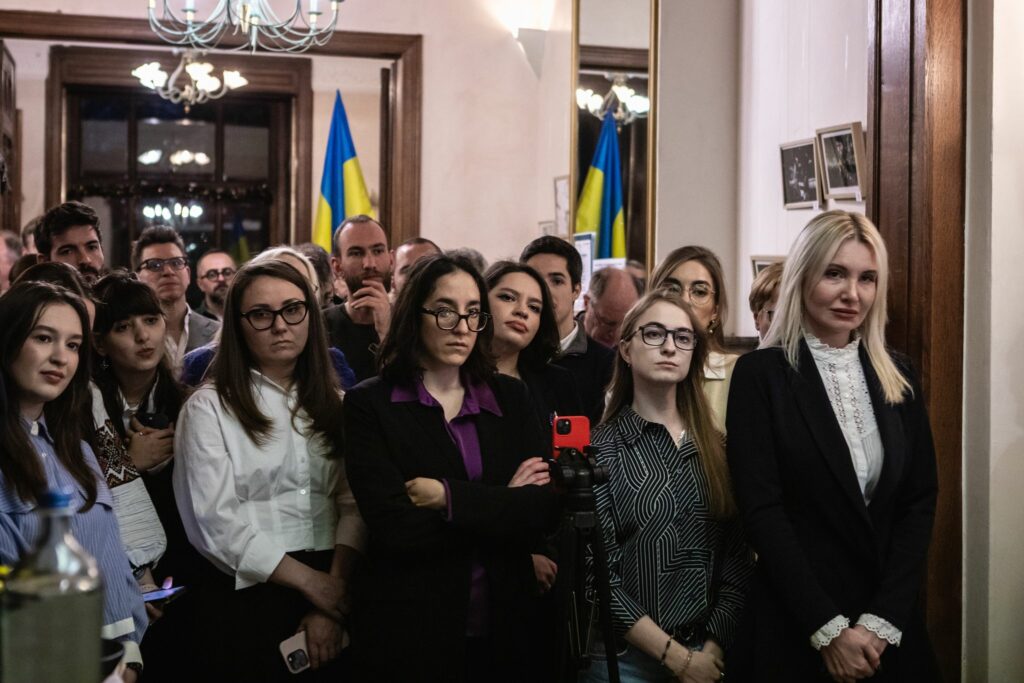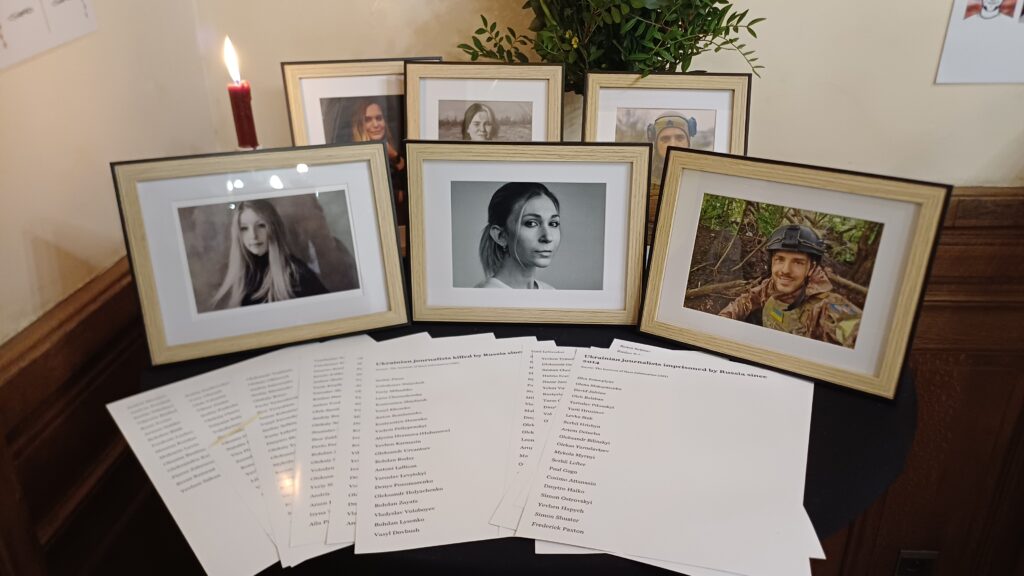
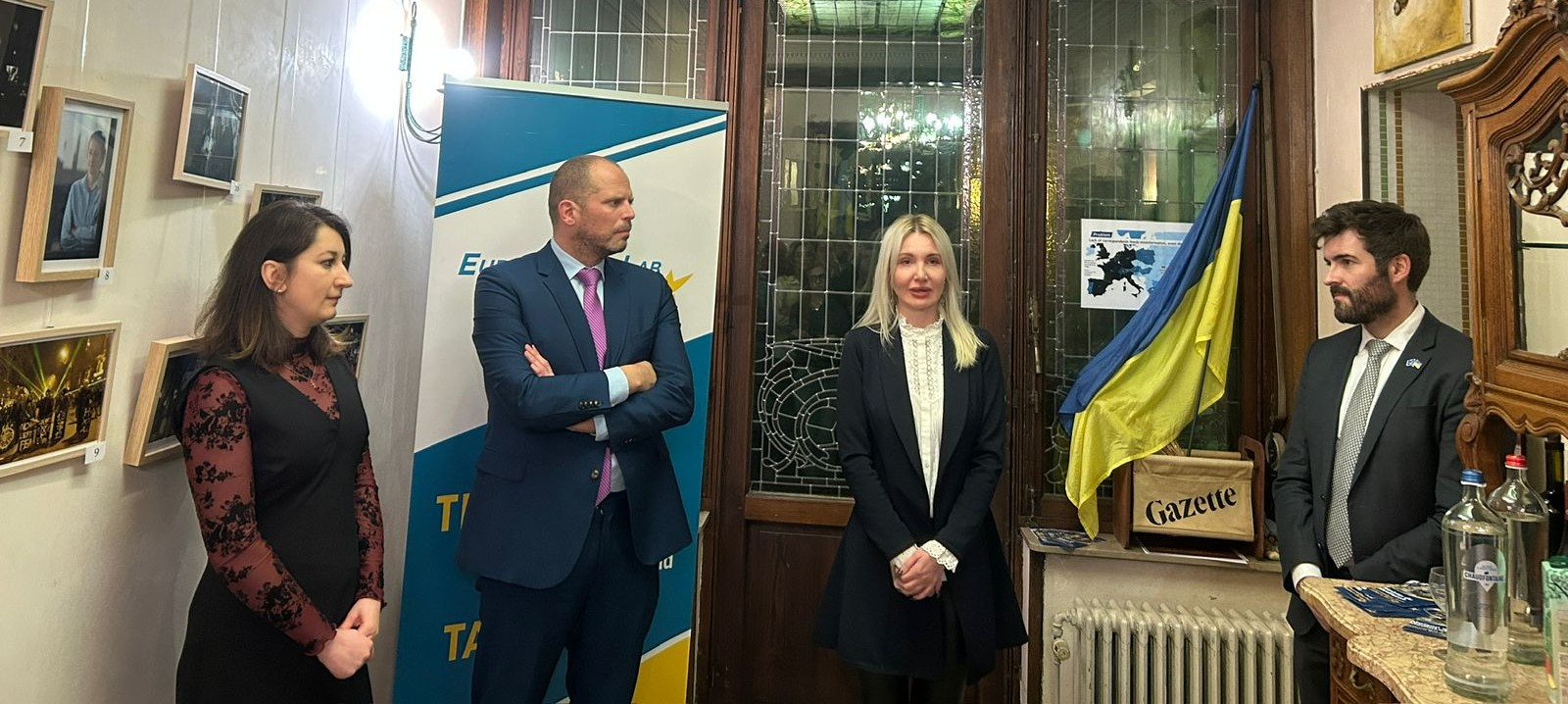
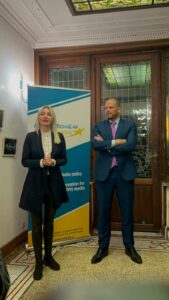
On February 26, Europe MédiaLab, in partnership with Promote Ukraine, hosted a commemoration reception in solidarity with Ukraine. The event honoured the civilians, soldiers and journalists who have lost their lives over the past four years of war against Russia. After a minute of silence, high-level speakers shared important remarks:
Aliaksandr Babiy: It has now been more than a year since we launched Maison du MédiaLab with Ukrainians, but also Moldovans, Georgians, and Armenians journalists and we are glad to see the results. We are glad to hear that these voices are being heard. We are glad to see that people in these countries better understand what the European Union is doing, what Belgium is doing, how Ukrainian frozen assets are being used, and also how disinformation about them is being spread and manipulated by Russia. And this is the most precious and important thing one can hear from policymakers, from the EU institutions, from NATO headquarters, from representatives of the Member States, and from a Belgian minister standing here in front of me today.
Theo Francken: I am supporting Ukraine from day one, because you’re fighting for sovereignty. You’re fighting for your own identity. You’re fighting for your own language. I feel so much emotions and bounded with with Ukrainian people. You can count on us and our Prime Minister.
Alberto Fernández-Díez: Four years ago, I was working in trade. At that time, everything was about the alignment of standards, trade flows, and integration into the European internal market. Nobody imagined that Ukraine would become a Member State. This possibility was simply not on the table…After the war began, we realised (and Ukrainians themselves realised) why they were in this situation. It is because they chose, in 2014 and even before, to move towards the European Union. It is a question of values. It is a question of the choice made by a nation and by its people… Enlargement is no longer only about joining the EU because of the benefits it brings. It is about the values that it represents. It is about the democratic system that underpins those values — respect for minorities, languages, cultures, and the broader institutional framework.
Inga Yakymenko: When I woke up on 24 February to the sound of explosions, I was very scared. Truly scared. I hope none of you will ever experience that feeling. But what I remember most about that moment was my first thought. I will remember it for the rest of my life. I realised that I was afraid of living under a Russian regime, of losing the freedom to be Ukrainian, simply to be Ukrainian. That was my greatest fear… So today I would like to ask all of us not to see this day only as a commemoration, but also as a lesson. Maybe we feel far away from the front line. Even we Ukrainians sometimes think that we are far away from it. But the enemy is often closer than we think. First of all, it comes into our minds, into our ideas, into our culture. Please do not take freedom and the values we have in the democratic world for granted.
Marta Barandiy: Today is the eve of the Day of Occupation of Crimea, which began 12 years ago… Not four years, but twelve…Thanks to the people who kept Ukraine on the international agenda all those years before the full-scale invasion, thanks to the volunteers who helped the Ukrainian front line, supported Ukrainian hospitals, and assisted the media. Thanks to them, Ukraine was able to withstand those eight years. During that time, the European continent and the international community often did not fully realise that a war was already taking place on our soil, because it was our people — the Ukrainian nation, our fighters — who carried that burden. We are not victims. We are fighters. We have proven that, although we never wanted to prove it. It happened because we are inherently European. We believe in dignity, and dignity is the core value that is worth defending, even at the highest cost. I am very grateful to everyone who is here today, and I ask you not to give up on Ukraine
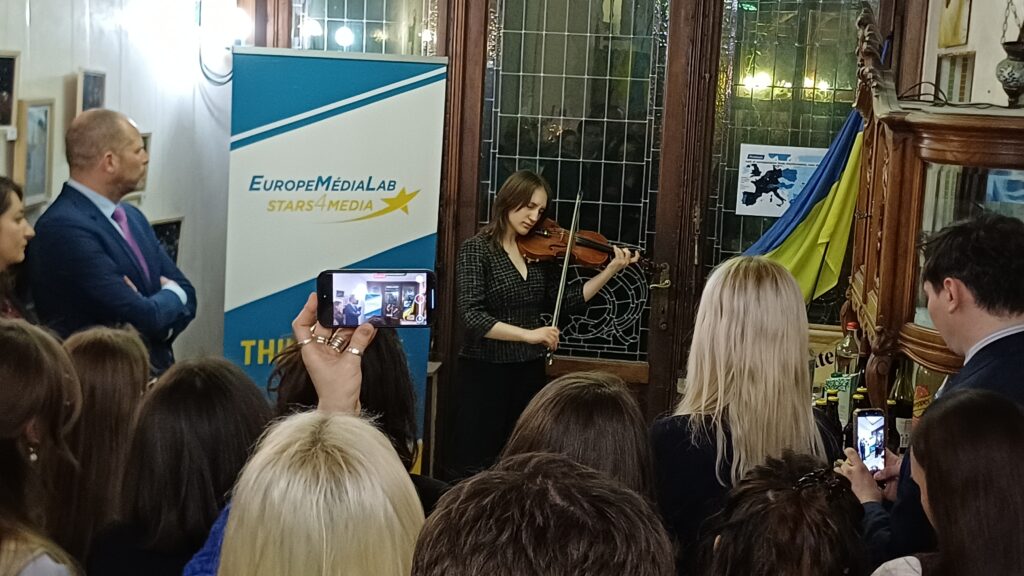
Following the speeches, Lana Herasymenko, a violinist from the Donetsk region, a refugee and musician at the Royal Conservatoire of Brussels, performed in honour of her country.