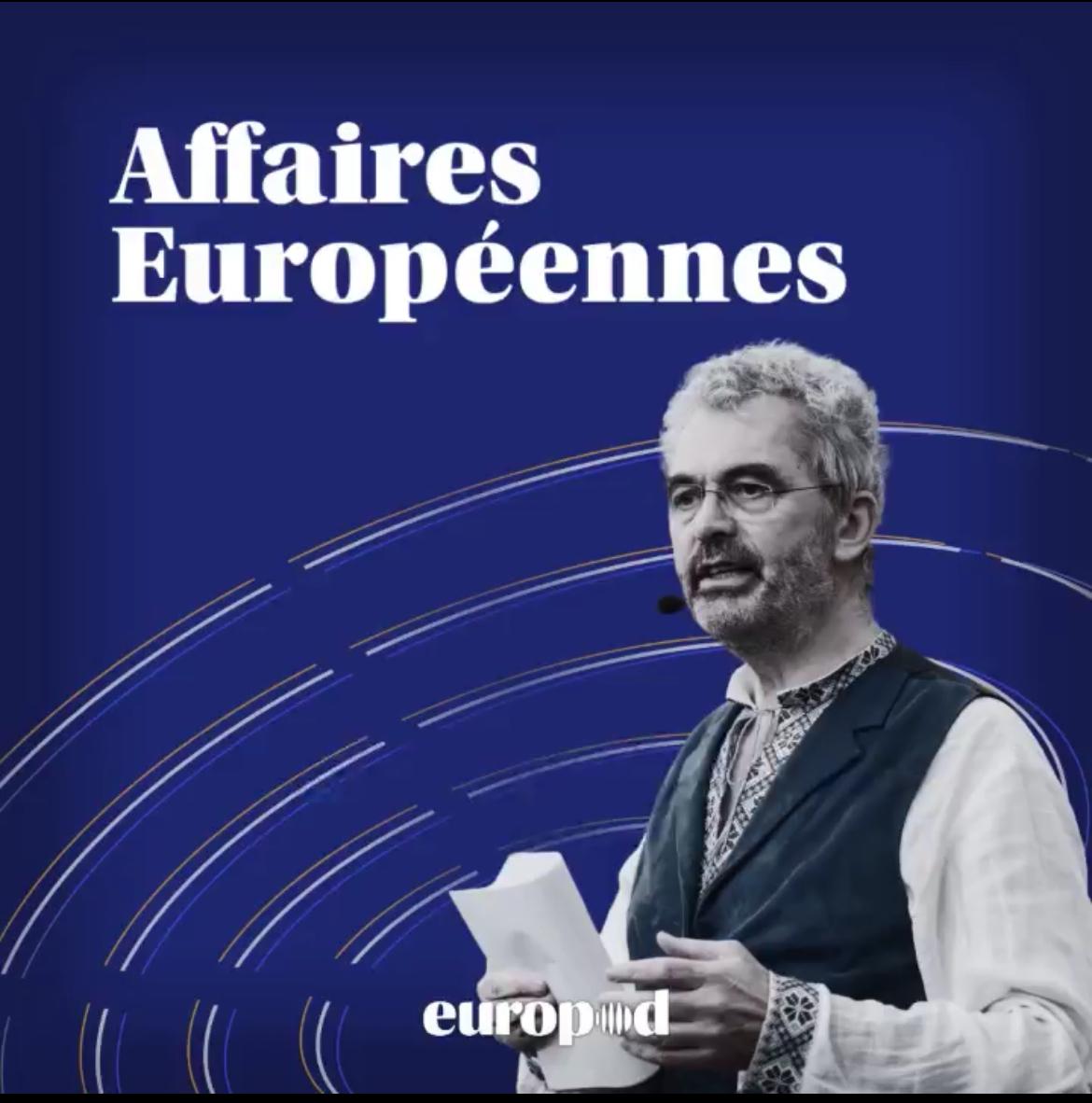
Christophe Leclercq was invited to take part in “Affaires Européennes”, new Europod’s podcast. In this third and final episode of *Affaires Européennes*, the issue of European media is examined from a broader perspective: that of informational sovereignty. Since the initial debates on the creation of a major European media outlet, the news landscape has undergone a profound transformation. Digital platforms, followed by artificial intelligence, have disrupted the sector’s balance and shifted the crux of the problem: beyond the media themselves, it is now control of the information space that is at stake. Faced with the dominance of major global platforms and the risks of disinformation, can the European Union really regain control? Is regulation enough, or is there a need to develop new European information infrastructures?
Antoine Lheureux: Thank you for listening to European Affairs. In the first two episodes, we analyzed how the media gradually entered the field of European public policy, and then how power relations in particular prevented the emergence of a major European media outlet. But is this issue still central? Since this debate began, the information landscape has been profoundly transformed by the arrival of digital platforms and now by artificial intelligence. In this third episode, we address the issue from its most political angle: the European Union’s ability to regain control of its information space. And we do so once again with Christophe Leclercq, founder and former director of Euractiv and now director of the Media Lab think tank.
Before getting to the heart of the matter, a word about Europe MediaLab—how would you describe it in two words, and what is its legitimacy on the subject I described in the introduction?
Christophe Leclercq: Who am I to talk about this? Good question. In addition to having… I apologize, but you made a top list, so I’m going to re- I’m going to re- It was good anyway, Roche. Deep down… Should I go? You go. Basically, who am I to talk about this legitimately? Good question. In addition to having created Euractiv, which has expanded into 12 countries, which is quite substantial, I was also part of the so-called high-level group of experts on disinformation in 2018. And since then, our organization has been part of the circles that deal with fact-checking and disinformation, notably the European Digital Media Observatory. So, what is our Think Do Tank, as we call it? We like the “do” aspect. Jean Monnet said that action inspires reflection, not reflection that inspires action. We have three main pillars. First, in parallel with Euractiv, we launched the Stars4Media media innovation program, which has helped 130 media outlets accelerate the modernization of either their newsrooms or their revenue models. Second, we launched the Maison du MédiaLab, which aims to triple the number of Eastern European press correspondents in Brussels. There were very few, given the upcoming enlargement. And thirdly, Trusted European Platforms. For us, Trusted European Platforms are more about reflection and certification based on what others are doing.
Antoine Lheureux: Trusted European Platforms are directly related to our topic today, which concerns our information space. In this regard, for several years now, the European Union has been concerned about the deterioration of this space: disinformation, polarization, loss of trust. In your opinion, at what point does this issue become a real political problem, and not just a temporary issue linked to election periods?
Christophe Leclercq: Traditionally, the European Union deals with these issues a year before elections, and that’s too late. It’s too late to create what I would call the infrastructure of democracy. Journalism, on the one hand, and social media, on the other, are the major infrastructures of democracy today, complementing institutions such as parliaments, of course. We need a slightly more visionary policy. For the moment, journalism in Europe, apart from the specialized media, is essentially national and therefore, in a way, sovereign. On the other hand, social media platforms are mainly American or Chinese, and that is a problem.
Antoine Lheureux: And today, it’s a political issue. Was this problem identified as soon as it emerged in the early 2000s, when platforms first appeared? Or did it take longer?
Christophe Leclercq: It became a real problem during Trump’s first election, and unfortunately, we wasted time. That’s when we should have created our own infrastructure. Because at the beginning of the Internet’s rapid development, Americans were very welcome here. And in fact, in our high-level expert group on disinformation, the only thing that was suggested to us was self-regulation. And we fought for co-regulation, i.e., self-regulation plus regulation when necessary. But the American and European platforms have an army of lobbyists and lawyers in this city. And it was only a year ago, with Trump’s second term, that we realized this would no longer be possible. During the previous term of the European Union, we developed a legal arsenal, DSA, DMA, and Media Freedom Act, which are very good. From my point of view, they must be implemented in a way that is neither strict nor lax, simply by applying the principles, but that is not enough. Trying to regulate is no longer enough. We need trusted European platforms.
Antoine Lheureux: In other words, do we need to adopt a genuine European industrial policy for digital technology?
Christophe Leclercq: The term “industrial policy” was somewhat taboo in the past. It was perceived as a French idea. Today, it is a continental idea that is widely promoted, for example in Germany. Yes, the European Union is aware of this problem. In addition to regulation, it is currently developing the budgetary dimension. So, in the long-term budget priorities, there is a new program called AgoraEU, and a much greater emphasis on the infrastructure of democracy rather than on cultural industries in the traditional sense. That’s good, but on the one hand, it’s an extremely slow development. We are talking about long-term priorities that are far from being achieved at the moment. And on the other hand, I don’t think subsidies for European social media are the main key. It can help in terms of supporting innovation, but the key is the market.
Antoine Lheureux: Does this mean that information space should be considered a strategic issue on the same level as energy or defense?
Christophe Leclercq: Absolutely. In addition to regulating existing platforms, we must encourage the emergence of European platforms that we consider trustworthy. Some already exist. There are two types of platforms currently being developed. On the one hand, there are those created by large audiovisual groups, mainly in the public sector, notably grouped together in the European Broadcasting Union (EBU), which organizes Eurovision, so they know how to reach very large audiences. On the other hand, there is Arte+, the Franco-German channel. There are other projects such as SEE.EU, which is a startup in the field of radio and television. The other major group is what are known as pure players, i.e., new creations. I would mention W, which was launched in Davos a few weeks ago, and Monnett in Luxembourg, which complements a platform focused on free software called Mastodon. That makes six already. They all want to be certified so that public institutions and advertising circles in particular know that it is worth working with them.
Antoine Lheureux: Labeling trusted actors—this brings us to the central idea of Trusted European, a European trust platform in French, the concept that you advocate with Medialab. More broadly, what does this notion encompass?
Christophe Leclercq: On the one hand, it’s about getting the private market and public institutions to work together. And on the other hand, it’s about accelerating something that already exists. So we have a wave coming. Being old enough to remember the dot-com wave, I can see that there is going to be an explosion of initiatives. Unfortunately, there are several pitfalls, notably the false sovereign. I will draw a parallel with what is happening in the field of business services. We have the sovereign cloud. The cloud refers to the data centers that manage our data. Far too many of them were in the United States. Now, data centers are being created in Europe, and some are subsidiaries of American groups. So, in fact, the keys to the data centers are still in Silicon Valley. That’s what I call the false sovereign. And I wouldn’t want it to be just Facebook or YouTube developing European subsidiaries, putting up a little 12-star flag and saying, “Trust us.” We want true sovereignty and therefore clear criteria on the European nature of these platforms and, on the other hand, on their compliance with trust rules.
Antoine Lheureux: I’m going to ask you a slightly provocative question, but there have been many initiatives that haven’t really worked. Why would this one actually work? What makes you confident that this label you’re promoting will work?
Christophe Leclercq: I would say three things. First, it’s existential. If we don’t do this, our democracies will collapse. We’ve been seeing a rise in populism for a long time. For now, the European Parliament remains relatively pro-European in its majority, but it’s not a done deal. Second, it’s a thriving market. Advertising on social media in Europe is worth €49 billion. It is growing by 6% every year. It is very profitable and oligopolistic. So, as a former McKinsey employee and former member of the European Commission’s DG Competition, I see a sector that needs competition. And it is possible. The Chinese have managed to enter our market against the Americans. If the Chinese can do it in our market, why can’t we? And the third thing is the conservatism of media management. Conservatism does not exist when you create new things, so you can start with new, younger teams who immediately adopt the latest technologies. It’s not about making copies of Facebook or YouTube. It’s about directly targeting services that will work well in the era of artificial intelligence.
Antoine Lheureux: What do you expect from institutions? In practical terms, you are promoting this label, you are active, you are lobbying, you are bringing together a number of stakeholders. What can or should they do, given that this is an existential issue?
Christophe Leclercq: They must continue to implement regulations and vote for some aid for innovation. In addition, there is the Trusted European Platform label. It will exist anyway, but it would be good if it had the blessing of the European institutions. And the European Parliament is moving in that direction. The Commission could do two very concrete things: create a group of experts to detail and, in a way, confirm the criteria for being trustworthy and European, and, secondly, conduct a feasibility study on the means to be implemented, which will facilitate these new platforms’ access to capital and then to the advertising market. So, the European Union can content itself with being a simple catalyst in a market that is emerging and will function anyway.
Antoine Lheureux: So, the other players, you, the emerging companies, and the sector as a whole—does everyone ultimately need to do their bit?
Christophe Leclercq: Yes, absolutely. We all know the players themselves. They are open to this Trusted European label for platforms. Institutions are always a little slow, but I think things will speed up. On March 19 and 20, there will be a meeting of the Council of the European Union, where the leaders of our countries will gather. They are already preparing for this Council, which is set to be very important for defense, digital sovereignty, and competitiveness. This is based on the Draghi and Letta reports, which must finally be implemented. There is already talk in the corridors of including a reference to trusted European platforms. I wouldn’t be surprised if this were included in the conclusions of the summit.
Antoine Lheureux: That’s an important step for you. Next step. This label exists; it is currently being created. You are identifying the organizations that will ultimately be required to carry this label. What are the next steps for you, in very concrete terms, on this issue of trustees of the trust repository?
Christophe Leclercq: We are continuing to work together to develop this label. It is not a question of imposing it, but of being firm on certain criteria. Once these have been detailed, we will then determine the body that will award this label, with regular updates to avoid false claims. And then we will enter a communication phase at various specialized media events and platforms, and also do a roadshow or accompany the roadshow of individual platforms that are currently raising capital.
Antoine Lheureux: What this exchange shows is that the issue of European media can no longer be considered in isolation. The stakes are now higher: the European Union’s ability to organize an information space that is pluralistic, reliable, and democratic in an environment dominated by global players and rapidly changing technologies. Regulation remains necessary, but it is no longer enough. This is undoubtedly where a significant part of European democratic sovereignty will be at stake in the coming years. Trusted European platforms could be part of the solution. Christophe Leclercq, thank you. I would like to remind you that you are the founder of Euractiv, one of Europe’s leading media outlets, which you ran for over 20 years, and that you now head the Europe Media Lab think tank. To find out more, visit www.Stars4Media.eu. Useful links can be found in the description of this episode. Thank you for listening. See you soon for the next episode of European Affairs