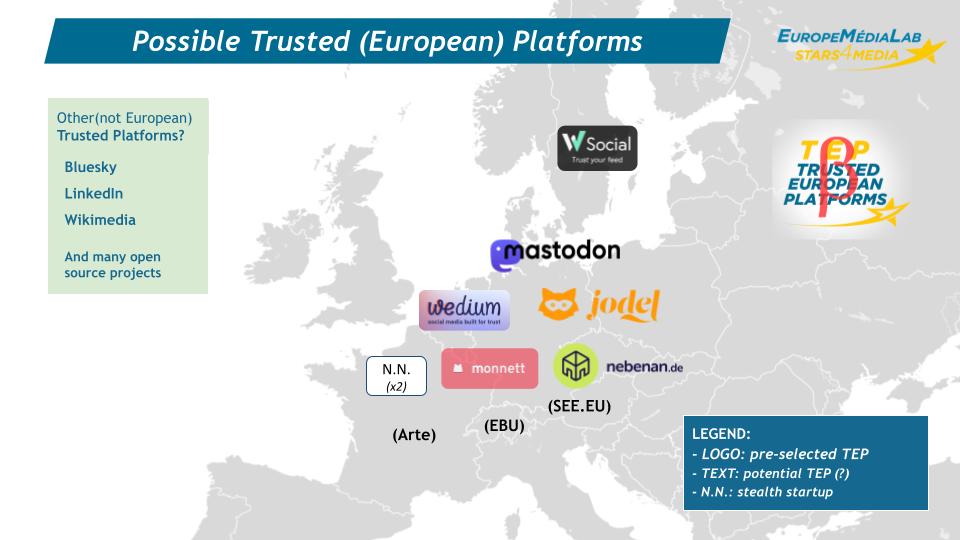
Trust and sovereignty are essential for Europe’s future: yet, both face unprecedented digital threats. External influences, growing louder, now directly challenge our democracies. Consequently, Europe must move beyond merely trying to regulate existing platforms to supporting the development of Trusted European Platforms (TEPs). This means scaling existing European alternatives to harmful networks like X/Twitter and TikTok, and building new platforms rooted in European infrastructure and values. The “Democracy Shield” proposed last November must go beyond enforcement and fact-checking subsidies and enable European innovation that meets market demands.
At the informal EU Summit on February 12, EU leaders discussed digital sovereignty as a key priority. Currently, US and Chinese oligopolies dominate most social media segments. As they prepare for the formal European Council on 19/20 March, with requests to the Commission, now is the time to transform good intentions into practical actions.
We, the signatories, represent three distinct groups: new pure-play platforms, broadcasters expanding into social media, and several supporting organisations.
A Smart Policy Framework
To build a trusted European digital marketplace, at least three pillars are needed:
Smart enforcement: EU laws such as the DSA, DMA, EMFA and AI Act must be enforced rigorously. Obligations need to differ by platform size to protect media SMEs. Beyond litigation and fines, we need an industrial strategy that includes procurement tenders, awareness campaigns, and funding for innovation and technical infrastructure.
Soft law for Trusted European Platforms: Europe must avoid lengthy legislative battles. Trusted European Platforms can instead be defined by voluntary standards grounded in EU ownership, governance, and trust principles. Independent evaluators would regularly assess labelled platforms and verify compliance. The “trust” label remains open to non-European platforms that voluntarily subscribe to these standards.
Market funding: VC, media, ads, licence fee: European platforms require a market-based model with limited public support. Social media advertising in Europe reaches €49 billion and grows by about 6% each year. The market is profitable and oligopolistic, calling for new competitors. New trustworthy platforms can gain market share and help demonetise disinformation. Partnerships with media may include equity deals and micropayments for article access. Scaling requires entrepreneurs, venture capital and sovereign funds.
Labelling TEP’s: “Trusted European Platforms”
European platforms need a trust-based advertising system to compete with global giants. Consistent labelling is one tool. The label “Trusted European Platforms” (TEPs) is being co-constructed around clear criteria.
Four criteria define the “European” dimension and prevent fake sovereign actors, as seen in the cloud debate. These include ownership and sovereignty, EU-based management and control, a real European footprint across several EU languages and countries, and credible platform size. Safeguards must also prevent takeovers by non-EU actors.
Four criteria define trusted platforms, including non-European ones. Platforms must comply with EU law and rights protection, avoiding micro-profiling, excessive data collection and undeclared bots. They require transparent and sustainable business models or public funding. Trust indicators should be reflected in algorithms, distinct from censorship. We support a European digital ecosystem in which platforms can collaborate and, to the greatest extent possible, interoperate to benefit users and society.
Launching European Trusted Platforms: Call to Actions
The EU does not need another “Twitter clone.” It needs sustainable and trusted platforms that reflect our values. We, the signatories, suggest the following actions:
- Set up a TEPs Committee to define trust criteria with media, advertisers, tech, venture capital, public services and policymakers. An independent attribution label body will then be created. This will emulate what rating agencies do for financial bonds, but much simpler.
- Political support: EU Council conclusions and Parliament report on Democracy shield could signal governments’ and MEPs’ commitment to a democracy infrastructure strategy, including trust and European roots
- Feasibility study: while we all have business plans, a shared analysis of the market perspective and of resources to scale would help
- Events and bootcamps: establish collaborative events – such as Eurosky live and Rebuild – where entrepreneurs, investors, and media experts co-develop European Platforms, marrying EU values with technical innovation and A.I.
Rebuilding Europe’s Digital Ecosystem
Europe has built ecosystems in aviation, film, telecoms, and clean tech. We can, and must, do the same for the digital public sphere. Ventures like Spotify and Mistral show what’s possible. We have the capacity to do more, and the market is ready for Trusted European Platforms.
As European Platforms and supporting associations, we are ready to lead this charge. But we need your support, whether you’re a policymaker, entrepreneur, investor, or citizen, similar to the support that American and Chinese platforms receive.
Together, we can rebuild Europe’s digital ecosystem, tailored to our needs and values.
The future of our democracy depends on it.
[Agreed signatories as of 12 March (plus a few potential ones)]
- Anna Zeiter, CEO, W Social
- Christos Floros, founder of Monnett
- Matthias Pfeffer, Founding Director, Council for European Public Space, Project Initiator, See.EU
- Sherif Elsayed-Ali, Co-Lead, Eurosky
- Christophe Leclercq, Founder of Euractiv & Europe Médialab, initiating ‘Club for TEPs’
- Johannes Meissner, Dr. Nele Meissner, Co-founders, Wedium
- Clare Melford, GDI, Global Disinformation Index (also on US black list re: fight against disinformation)
- Paul Nemitz, Visiting Professor of Law at the College of Europe
- Omri Preiss, CEO, Alliance4Europe