
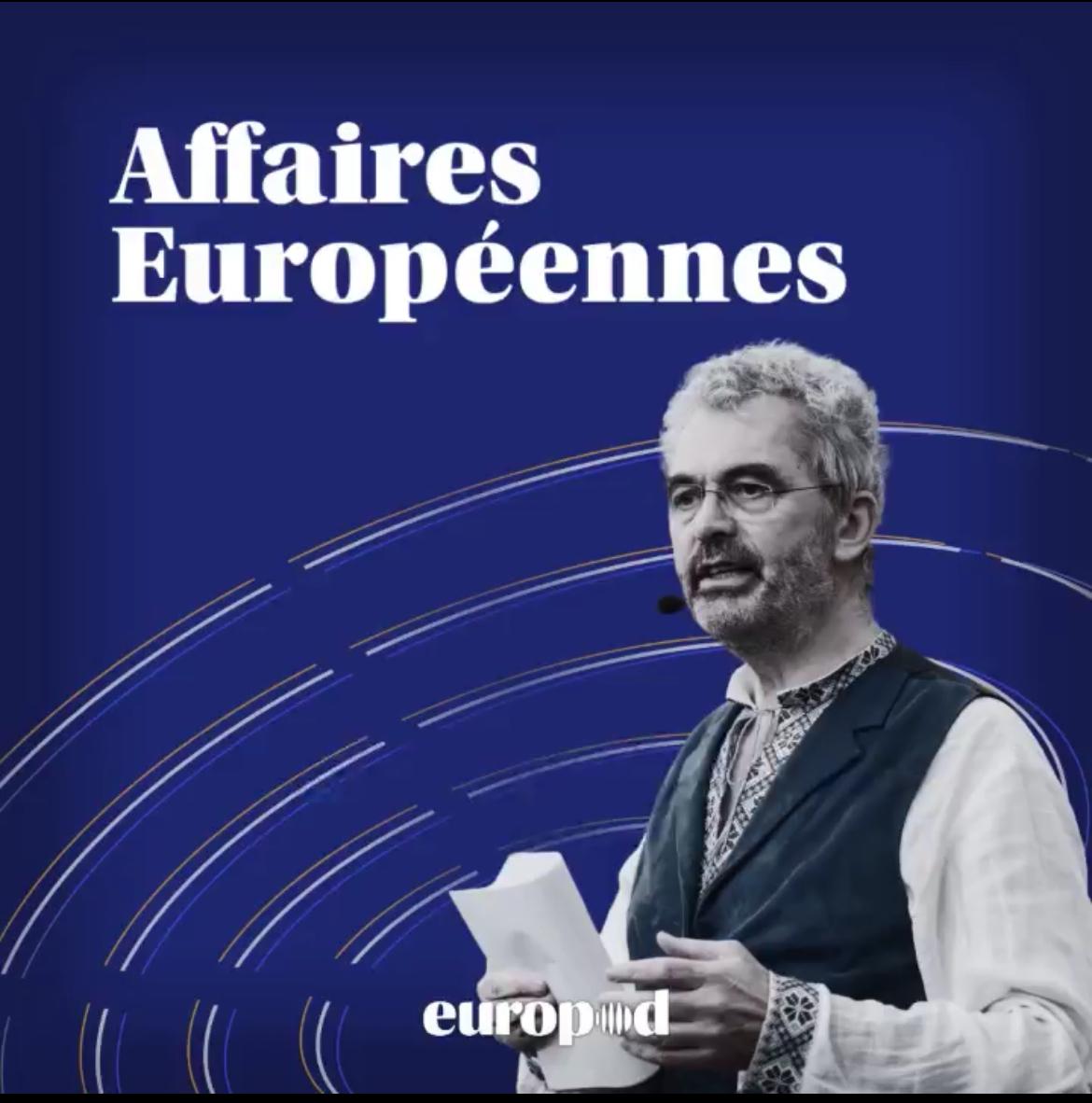
Christophe Leclercq has been invited to participate in Affaires Européennes, a new weekly podcast offered by Europod. The second episode is now available, with the last one to follow next week!
In this second episode of European Affairs, Christophe Leclercq, analyzes the political and economic reasons which explain why there is not a big European media outlet. Relations between media and national governments, economic models weakened by the internet, domination of digital platforms and difficulty in bringing out transnational actors. etc. This episode explores the balance of power that structures the European media landscape today. The transcription below.
Antoine Lheureux: Hello and welcome to the second episode of European Affairs. We continue our discussion with Christophe Leclercq, founder and former CEO of Euractiv. In the first episode, we saw how the media has gradually entered the field of European public policy. In this second episode, we shift our focus. It is no longer just about public policy, but about power relations. Why, despite the emergence of influential specialized media in Brussels, is there still no major European mainstream media outlet? What political, economic, and institutional forces are hindering its emergence?
Christophe Leclercq, the explanation often given for the absence of a European mainstream media is the lack of a genuine European public sphere and cultural habits that are too different. In your opinion, is this the main reason, or is it an argument that masks other, more structural obstacles?
Christophe Leclercq: I have long said that a European public space is a dream that I share, but a dream nonetheless. Today, it is beginning to exist. Why are the media either ultra-specialized in Brussels or national? There are several reasons for this. We always mention languages, supposedly a barrier, and also different cultures. That’s true, but it wouldn’t necessarily prevent the emergence of media groups that are specialized publications, adapted to different languages and cultures, targeting a specific audience or specialized topics. Of course, it’s not possible to create a large media outlet that covers everything for everyone. That doesn’t exist. A media outlet is defined by its content, but above all by its specific audience. The political context is that the media are primarily the preserve of national governments, much like defense or education. For a long time, the European Union was perceived by media publishers as a problem.
Antoine Lheureux: What do you mean?
Christophe Leclercq: Essentially, restrictions on advertising, which is a significant source of revenue for private media, and also controls on media concentration. Most of the Commission’s colleges in the past had a group of experts or a group of commissioners whose primary task was to try to implement competition rules at the national level, with a great deal of reluctance on the part of the governments concerned, of course.
Antoine Lheureux: So the EU bears some responsibility for the current situation?
Christophe Leclercq: I think it is partly responsible. In the past, the European Union has dealt with major sectors such as steel, agriculture, automobiles, etc. It has proceeded tentatively, I would say, in the media field. Within the European Commission, we have DG Connect, which has media support policies that came from DG Communication. And that was a good thing. This has been consolidated within the Media Directorate, which has been in existence for 11 years. And I assumed that an industrial policy would be developed around this, which was also called for by MEPs. But instead of an industrial policy, we got a regulatory policy that focused mainly on regulating American platforms, DSA, DMA, Media Freedom Act, and others. These are good developments, which I believe are solid and need to be implemented, but they are completely insufficient.
Antoine Lheureux: If we look at the media sector from an economist’s perspective, how does its economic model make it particularly difficult for a large European player to emerge?
Christophe Leclercq: In principle, the evolution of the economic model should encourage the emergence of larger players. New revenue models have not been sufficiently explored. The main factor, the elephant in the room, I would say, is the arrival of the Internet. The Internet has reduced the two main sources of media revenue: advertising, 90% of which has gone to American platforms, and subscriptions, which have been replaced by access to free content. Subscriptions have been picking up a little lately, but it’s still not enough. Therefore, media outlets would likely have developed more quickly on a European scale if they had been thriving and if investors had been interested in this sector. Instead of investors attracted by the economic growth of this sector, we had oligarch investors who were more interested in acquiring influence or, at the very least, a good reputation.
Antoine Lheureux: And today, the media sector finds itself in a worrying situation. Is this inevitable, or is there hope?
Christophe Leclercq: For me, there are three ways for the media to evolve. The main one is to die. And that’s what happened to most of the titles that existed in the past. Over the last 20 years, we’ve lost half of the journalists who worked in the media in Europe. The second way is cooperation, which is the traditional model in Europe. Sometimes cooperation is a little superficial and, above all, we don’t go into each other’s markets. This is the principle of market sharing, which is not necessarily illegal from a competition law perspective, because we are talking about relatively small, national markets. And the third way is consolidation. This is the consolidation that I would like to see, which can be done in some cases, but which is currently insufficient.
Antoine Lheureux: Why consolidation?
Christophe Leclercq: Because we are moving from a variable cost sector to a fixed cost sector. Fixed costs must be spread over larger areas. Think about traditional media, such as print newspapers. Printing newspapers, distribution, etc., were variable costs that could justify newspapers on a very small scale. Today, these are essentially fixed costs. First, journalists and especially networks of journalists, which we can expect to be a fixed cost. Second, everything related to IT, from traditional IT to content management systems and artificial intelligence. And third, promotion, the creation of new products and brands. I would also point out that media brands remain very powerful. They are their main asset. And we could certainly consider grouping brands together while preserving them, pooling the fixed costs of IT and preserving national brands and therefore also national newsrooms within larger transnational groups. Because at the moment, the problem is that the European media are a myriad of dwarfs facing an American oligopoly.
Antoine Lheureux: You talk about consolidation, but transnational media consolidation is sometimes perceived as a threat to press freedom. Is this a false debate, or a political red line that cannot be crossed in Europe?
Christophe Leclercq: I think it depends on the conditions. Let’s take Central Europe as an example. At the time of the major enlargement in 2004, there were many more Western media groups, mainly German, Swiss, and American—the Americans were good at the time—investing in Central Europe. And it was a time of both quality and pluralism in those countries. Since then, economic models have deteriorated. The value of these assets has declined, and oligarchs have bought up these media outlets, and now they are being subsidized by national governments or used to buy influence. The press has deteriorated significantly in Central Europe, whereas the previous transnational phase was much better. If Western media outlets in Europe were to come together, they would, of course, retain their national brands and their teams of journalists at the national level, and they would concentrate on what I have called fixed costs by becoming more competitive. This would also enable them to be more united in negotiations with GAFA, which are very important in terms of copyright and, in the future, artificial intelligence.
Antoine Lheureux: If we consider all these economic, national, and institutional power dynamics, can we still imagine the emergence of a major European media outlet… or do we need to completely rethink the way Europe structures its information space?
Christophe Leclercq: I think we need several major European media outlets. They should be united not by a common language in the future, but rather by a common orientation. There is certainly the possibility of developing media outlets, but much more social media for young people. I would find it quite logical for some major center-left newspapers to come together and for some center-right newspapers to come together separately as well. As for nationalist media outlets, it will be more difficult for them to agree, of course.
Antoine Lheureux: What you are describing, Christophe, is therefore less the absence of a European public sphere than the result of a tangle of economic, national, and institutional power relations. In other words, the absence of a major European media outlet is not due to a lack of ideas or talent, but to deeply entrenched balances that neither the member states, nor the European Union, nor even the media players themselves have really sought to upset. This situation ultimately highlights the structural limitations of the European media landscape today.
But is this still the central issue?
Christophe Leclercq: Since the debate on a European media outlet began, the sector has been profoundly shaken by the arrival of digital platforms. The challenge is no longer limited to the emergence of European media players, but to the European Union’s ability to preserve a pluralistic, reliable, and democratic information space in an environment dominated by global platforms and, increasingly, by artificial intelligence. It is this shift that we will address in the third and final episode of this mini-series: the European Union’s policy choices in relation to platforms and AI.