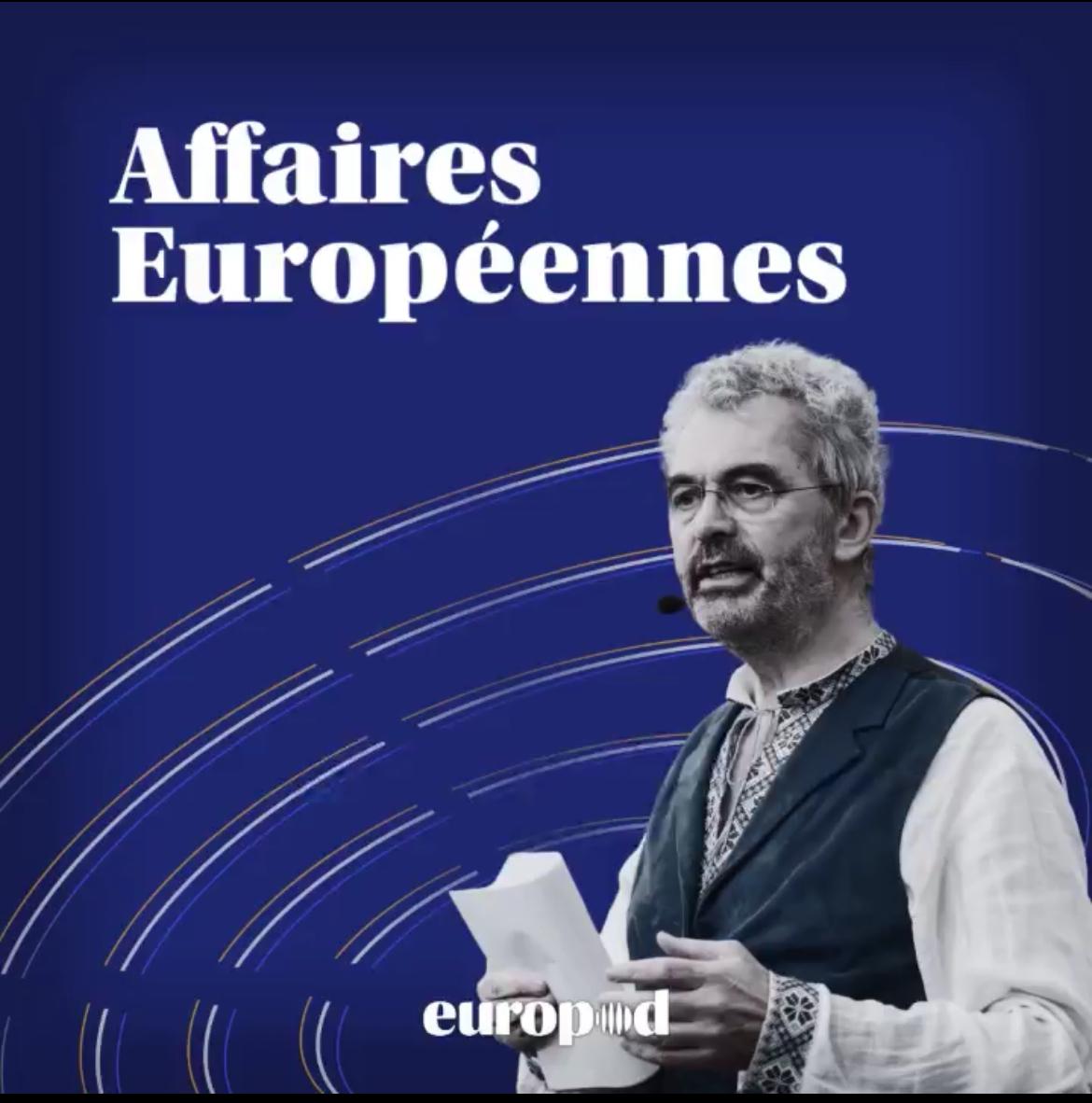
Christophe Leclercq has been invited to participate in Affaires Européennes, a new weekly podcast offered by Europod. The first episode is now available, with two more to follow in the coming weeks! Affaires Européennes takes listeners behind the scenes of the European decision-making process, giving a voice to those who shape policy across the continent. For this launch series, the focus is on a sector that has become increasingly strategic in Brussels: the European media. Below the transcript.
Antoine Lheureux: Hello and welcome to the first episode of European Affairs. Each week, we go behind the scenes of European decision-making, with those who shape it, to understand the issues, trade-offs, and political choices involved. To kick off this series, we take a look at the European media sector. We will try to understand what it is, how it has gradually entered the field of European public policy, what power relations structure it, and what political choices are now facing platforms and artificial intelligence. The subject is vast, so we will devote three episodes to it, with our guest Christophe Leclercq. A former member of the European Commission and the consulting firm McKinsey, you founded and ran Euractiv for 20 years, now one of the most influential European media outlets in Brussels, which you recently sold. You remain very involved in the European media ecosystem, notably through Europe Media Lab, the think tank you lead. You advocate the concept of Trusted European Platforms, which we will come back to. But for now, it’s time to start this first episode. Let’s start by going back 25 years, to 2000. That was when you left the European Commission to launch Euractiv, at a time when there were high expectations for transparency following the Santer Commission crisis, the arrival of the internet, and the first debates on the future of European information.
How were the media perceived at that time from a European institutional perspective: as a simple economic market or already as a political and democratic issue?
Christophe Leclercq: The European Union has always had a communication deficit, and at the time, the media were viewed in a rather utilitarian way as a means of communication rather than a means of providing information and supporting open and critical debate. This was particularly true of the specialist media. There were three such outlets before the arrival of Euractiv: Agence Europe, Europolitique, and European Voice. And it was also true of national press correspondents. But all that has changed.
Antoine Lheureux: What, at that time, made the emergence of specialized European media outlets such as Euractiv possible and necessary?
Christophe Leclercq: There are two main things. On the one hand, there is a great need for transparency, not only with regard to official documents, various meetings, etc., but also, and above all, with regard to the positions taken by European actors, as they have been called, i.e., essentially industry and NGOs. We had to move away from the institutional framework. And secondly, a large number of issues that were not previously on the European agenda have now become so. We had an energy policy, there were budget crises, and now there is a military crisis. In short, many issues that were purely national have become European, so press coverage had to be expanded, including in a more specialised and in-depth manner. That is what we have tried to do with Euractiv.
Antoine Lheureux: In this Europeanization of subjects, what role did language play?
Christophe Leclercq: We had to leave Brussels and the monolingual Euractiv to keep up with this change.. For a long time, the press room was exclusively French-speaking. That was the case until the end of the Delors commissions and even a little after that. Then it was opened up to English, and today it has essentially become monolingual. So we went from one form of monolingualism to another. It is clear that the media have a role to play in relation to citizens who express themselves in many other languages. So there was work to be done in this area, and several organisations have tried to do this, notably Agence Europe, Euronews and Euractiv itself. As for Europolitique, it existed in two languages, but that company has disappeared.
Antoine Lheureux: And since then, how have the specialized media evolved?
Christophe Leclercq: Other developments that can be noted in the specialist media, I would say, are a dual dynamic, both of concentration, because many have died out. There were many small attempts, often between Brussels and a national capital, in English, German, Spanish, etc., which failed. On the other hand, there are new entrants who have been quite successful. And that has led to today’s specialized media sector, which is very rich, much bigger than it was at the time, both in terms of turnover and, above all, in terms of the number of journalists.
Antoine Lheureux: Returning to the European institutions, have you noticed a change in attitude towards the media over time, particularly towards specialized media outlets in Europe such as Euractiv? Can we identify a turning point?
Christophe Leclercq: I see two turning points. First, the acceptance of Euractiv and other online media by the press corps. It wasn’t easy at first to get accreditation cards, which seems hard to understand today. As for the institutions, there was a distinction between communication policy on the one hand and sectoral policy concerning the media on the other. In 2004, the Commission removed media support programs from the DG Communication. This was also when a commissioner specializing in communication and spokesperson was appointed, Margot Wallström from Sweden, while Viviane Reding from Luxembourg was in charge of telecommunications and media.
Antoine Lheureux: So it was in the early 2000s that the shift took place, under the influence of Margot Wallström?
Christophe Leclercq: Especially since this was the time of the two negative referendums in France and the Netherlands, which led to Plan D and a number of other initiatives to communicate with and listen to citizens. It was also at this point that we realized we needed to think about the economic strength of the media sector and try to start developing a sectoral policy. This had not been done for at least 10 years. There was awareness of these issues. This was also the moment when new economic models arrived in force. The media lost most of their advertising revenue, which went to GAFA, the American platforms. They also lost a large part of their subscriptions, as much of the information was available for free on the web. Euractiv was, in a way, part of the problem, but also part of the solution.
Antoine Lheureux: Isn’t the real blind spot, ultimately, the national level—where most of the political and media power still lies?
Christophe Leclercq: Absolutely. But the European Union is made up of member states first and foremost, not Brussels institutions. The problem is that the media, like a number of other things such as defense, was somewhat the preserve of national governments. There are symbiotic relationships, generally transparent, but symbiotic nonetheless, between national governments and the national press. And traditionally, in each college of the Commission, there was a group of experts or a group of commissioners who dealt with the media, mainly to limit media concentration and sometimes to support legislation that the media considered negative. For a long time, the media considered the European Union to be a problem by limiting their access to advertising, whereas today, the media hope that the European Union will take a more positive approach to their sector.
Antoine Lheureux: What does it mean to take care of their sector in a positive way? What exactly are the European instruments currently available to support the media—whether in terms of regulation, funding programs, or access to institutional information?
Christophe Leclercq: Today, there are two approaches that are relatively well used. The first is the regulatory approach. Certain obstacles to media development have been removed. It has been understood that distinctions need to be made. There are exceptions for the media, etc. Some media outlets, such as news agencies, have public service status. On the other hand, the budgetary aspect has long been controversial. The media themselves were not supposed to receive European subsidies.
Antoine Lheureux: It has long been controversial
Christophe Leclercq: Yes, agreed. On the other hand, the budgetary aspect has long been controversial. The media themselves were not supposed to receive European subsidies because they were generally linked to contracts that imposed a number of restrictions. They have become much more pragmatic today, while still trying to respect the principles of editorial independence, of course. About fifteen years ago, the European Union also tried to develop its own media. And we can say that, overall, it was not a success. I will mention them briefly. There is Euranet on the radio, which is still more or less continuing. There was Presse Europe, which aimed to translate the national press, but it was based on the experience of Courrier International, which continued to function well. However, the European extension did not last. There was a temptation for excessive control on the part of the European Commission. There was also a web TV channel around the European Parliament, which was really a very expensive white elephant and a complete failure. And then, indirectly, there is Euronews, which continues to be a controversial subject. Around €350 million has been invested in Euronews, which is still not as important as the national channels, but Euronews continues.
Antoine Lheureux: Looking back, can we say that the media has become a public policy issue in its own right at the European Union level? Or are we still stuck with an incomplete approach?
Christophe Leclercq: About ten years ago, the media department was created within the DG Connect Directorate-General at the European Commission. I was very hopeful about this department. Finally, there was going to be a sectoral policy for the media, treating them as an economic sector, like the automotive industry and, in the past, steel or agriculture. Unfortunately, however, the main focus has been on regulating GAFA, which is necessary but not sufficient. And it is only now that we are finally really concerned with a sectoral policy for the media as a whole.
Antoine Lheureux: We will come back to this. To conclude, what do you think the trajectory of a media outlet such as Euractiv reveals about how the European Union shapes its public policies: through successive adjustments, in response to crises, or through a genuine long-term strategy?
Christophe Leclercq: There has been no long-term strategy regarding the media. I could cite a number of reports, but ultimately, there have been many intentions and relatively few actions. Returning to the case of Euractiv, what has been very important is decentralization, i.e., partnering with media entrepreneurs in a dozen countries, typically with a publisher and an editor-in-chief taking charge, or with existing media groups, and thus decentralizing information about the European Union. The rest of the specialized press is mainly Anglo-Saxon. And now that Britain has left the European Union, this is a problem. A democratic government cannot function without a free press, and I would add a free and domestic press. We do not have a sufficient domestic press in the specialized media. That is why we at Euractiv chose to join the Mediahuis group, which is a Belgian group, in the hope that it will continue our independent, constructive, and multilingual approach. Only time will tell.
Antoine Lheureux: In this episode, we saw how the emergence of European media responded to a need: for institutions to become more open and to structure a continent-wide debate. We also observed how, gradually, the media sector entered the field of European public policy—in successive stages, through concrete instruments, in a dynamic that is still incomplete but now well established. But this development raises another, equally central question. If the European Union now recognizes the strategic importance of information, why is there still no major European mainstream media outlet? What power relations, economic balances, and political choices explain this absence? We will analyze this in the next episode of European Affairs, devoted to the power relations that structure the European media landscape. See you soon.